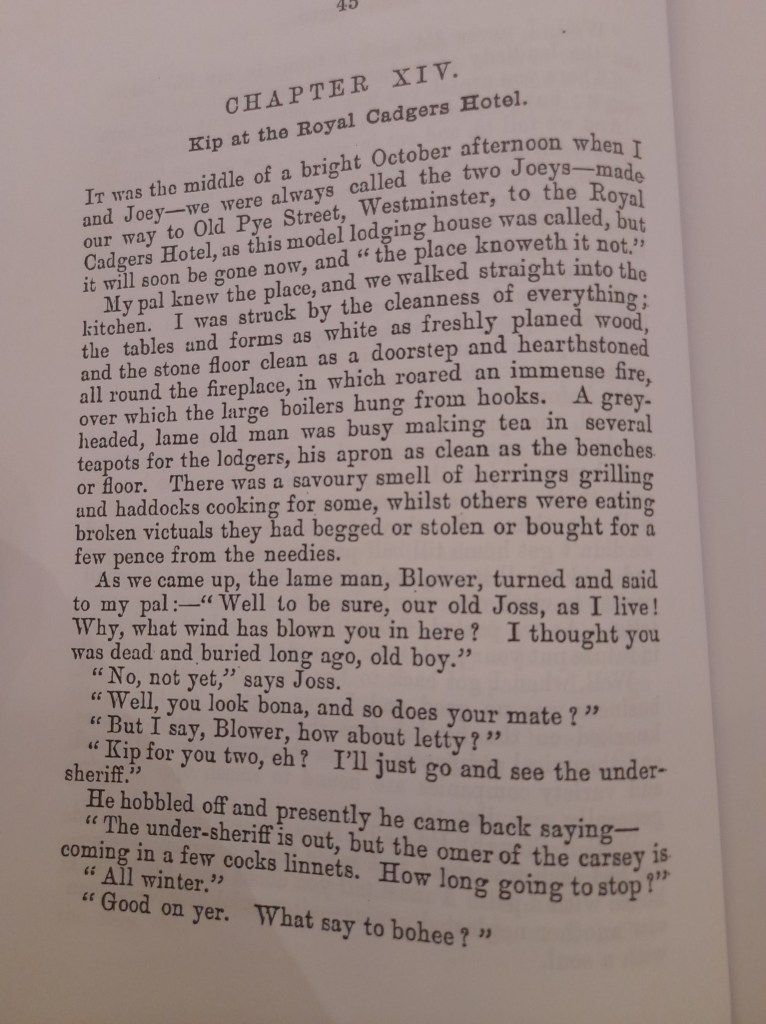
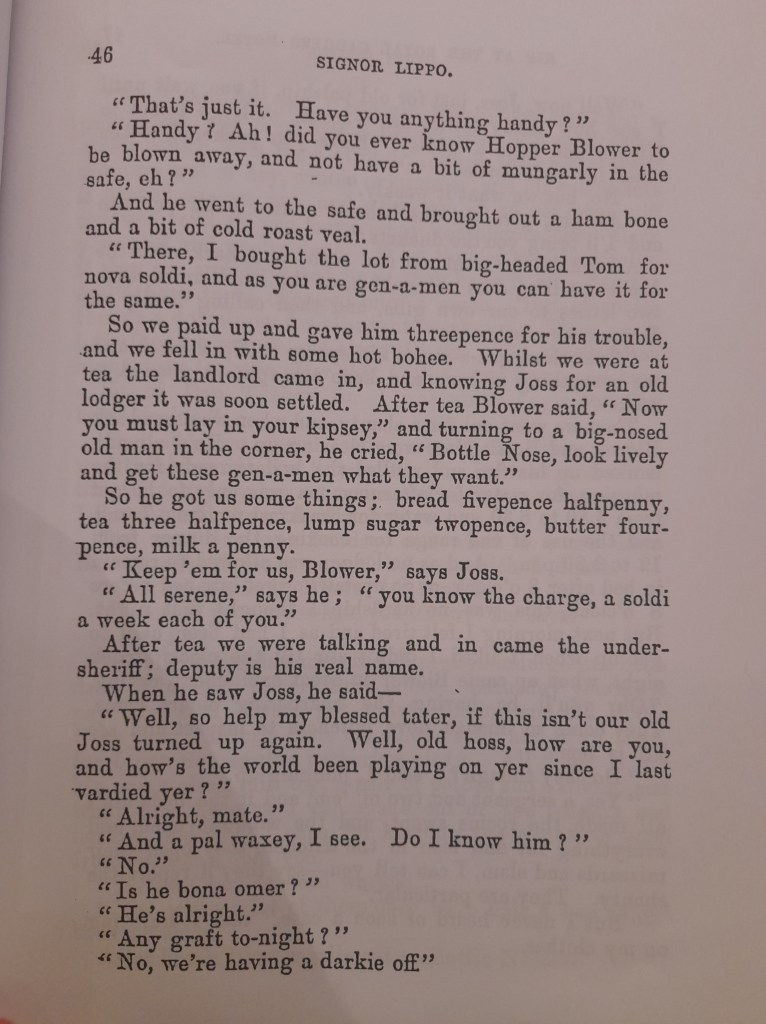
Whilst this website has taught a number of Polari words with corresponding example sentences, there have so far been no articles about literature written in Polari. For this reason, this article will be looking at an excerpt of a book titled ‘Signor Lippo’ which was written partially in Polari and published in 1893. Whilst controversial as it follows the story of someone who performs blackface for a living3, the book serves as a rare example of written Polari prior to the 20th century. The excerpt in this article does not allude to the more racist themes of the book,4 and therefore, only the language itself will be deconstructed. To do this, this article will be segmented into 4 sections: the excerpt itself, followed by three linguistic features of the excerpt (non-standard lexis, figurative speech, and grammatical peculiarities).
The Excerpt
The excerpt revolves around the main character (‘Signor Lippo’, also known as ‘Smith’) and his friend (‘Joss’) who encounter a long-lost acquaintance (‘Blower’) whilst looking for food and accommodation in a hotel.5 The excerpt is as follows:
‘My pal knew the place and walked straight into the kitchen. I was struck by the cleanliness of everything; the tables and forms as white as freshly planed wood, and the stone floor clean as a doorstep and hearthstoned all round the fireplace, in which roared an immense fire, over which the large boilers hung from hooks. A grey-headed, lame old man was busy making tea in several teapots for the lodgers, his apron as clean as the benches or floor. There was a savoury smell of herrings grilling and haddocks cooking for some, whilst others were eating broken victuals they had begged or stolen or bought for a few pence from the needies.
As we came up, the lame man, Blower, turned and said to my pal: – “Well to be sure, our old Joss, as I live! Why, what wind has blown you in here? I thought you was dead and buried long ago, old boy.”
“No, not yet,” says Joss.
“Well, you look bona, and so does your mate?”
“But I say, Blower, how about letty?”
“Kip for you two, eh? I’ll just go and see the under-sheriff.”
He hobbled off and presently he came back saying –
“The under-sheriff is out, but the omer of the carsey is coming in a few cock linnets. How long going to stop?”
“All winter.”
“Good on yer. What say to bohee?”
“That’s just it. Have you anything handy?”
“Handy? Ah! did you ever know Hopper Blower to be blown away, and not have a bit of mungarly in the safe, eh?”
And he went to the safe and brought out a ham bone and a bit of cold roast veal.
“There, I bought the lot from big-headed Tom for nova soldi, and as you are gen-a-men you can have it for the same.”
So we paid up and gave him threepence for his trouble, and we fell in with some hot bohee.’6
Non-Standard Vocabulary
Arguably the most overt peculiarity in this excerpt is the use of Polari vocabulary, as well as other non-standard words. These include the following (in order of appearance):
hearthstoned: surrounding (a hearth is an area around a fireplace)7
victuals: anything edible8
bona: good9
letty: lodgings10
kip: a bed11
omer of the carsey: the manager12
cock linnet: minute13
yer: you14
bohee: tea15
mungarly: food16
nova soldi: ninepence 17
Figurative Language
Within this excerpt and the book as a whole, there is a strong use of metaphors and similes. However, this may be more indicative of the literary style of the book itself, rather than being an inherent feature of Polari. The following examples can be seen within the excerpt (by order of appearance):
‘the tables and forms as white as freshly planed wood’18
‘the stone floor clean as a doorstep’19
‘what wind has blown you in here?’20
Peculiar Grammar
At various points of the excerpt, words are omitted or their order switched in such a way that would be blatantly incorrect in standard English. Here are the following examples:
‘I thought you was dead and buried long ago’21 – meaning ‘I thought you were dead and buried long ago’
‘How long going to stop?’22 – meaning ‘how long are you going to stop?’
‘What say to bohee?’23 – meaning ‘what do you say to tea?’
‘Have you anything handy?’24 – ‘Do you have anything handy?’
Note that in the last example, the sentence structure is slightly different from what would ordinarily be seen in English questions. Whilst yes or no questions normally begin with an auxiliary verb (i.e. ‘do’) followed by a subject (i.e. ‘you’), a main verb (i.e., ‘have’), and the other element (i.e. ‘anything handy’),25 the underlying structure is instead a main verb (‘have’), followed by the subject (‘you’), and then the other element (‘anything handy’). This sort of sentence structure appears quite common in Germanic languages, including in early modern English (think Shakespearean English).
Conclusion
By having a concrete example of Polari written at a time that it was used, readers can hopefully gain a greater understanding of the system of slang. Did you notice anything else from the excerpts which you found interesting? If so, feel free to comment below.
References
- P H. Emerson, Signor Lippo, Burnt-Cork Artiste. His Life and Adventures, Etc (Sampson Low, Marston & Co., 1893) 45. ↩︎
- Ibid 46. ↩︎
- See ibid. ↩︎
- See ibid 45-46. ↩︎
- See ibid 1-3, 45-46. ↩︎
- Ibid 45-46. ↩︎
- Oxford English Dictionary (online at 10 December 2024) ‘hearth’ (n1, def 1a). ↩︎
- Oxford English Dictionary (online at 10 December 2024) ‘victual’ (n, def 1a). ↩︎
- Green’s Dictionary of Slang (online at 10 December 2024) ‘bona’ (adj). ↩︎
- Green’s Dictionary of Slang (online at 10 December 2024) ‘letty’ (n1). ↩︎
- Green’s Dictionary of Slang (online at 10 December 2024) ‘kip’ (n1, def 2). ↩︎
- Green’s Dictionary of Slang (online at 10 December 2024) ‘omee’ (def 1). ↩︎
- Green’s Dictionary of Slang (online at 10 December 2024) ‘cock linnet’ (n2). ↩︎
- Oxford English Dictionary (online at 10 December 2024) ‘yer’ (pron). ↩︎
- Green’s Dictionary of Slang (online at 10 December 2024) ‘George Bohee’. ↩︎
- Green’s Dictionary of Slang (online at 10 December 2024) ‘mungarly’. ↩︎
- Green’s Dictionary of Slang (online at 10 December 2024) ‘nobba saltee’. ↩︎
- Emerson (n 1) 45. ↩︎
- Ibid. ↩︎
- Ibid. ↩︎
- Ibid. ↩︎
- Ibid. ↩︎
- Ibid. ↩︎
- Ibid 46. ↩︎
- Cambridge University Press & Assessment, ‘Questions’, Cambridge Dictionary (Web Page) <https://dictionary.cambridge.org/grammar/british-grammar/questions>. ↩︎
 Boyno Polari
Leave a reply to Nix My Dolly, Pals Fake Away: A Criminal Ballad – Boyno Polari Cancel reply