Whilst the lessons on this website have focused on individual words and phrases, this page will be looking at a text with Polari words and encouraging you to find out what it means.
In Polari, the words that are used can differ quite significantly from time period to time period, and from person to person. Polari was generally not written prior to the late 20th century. In many respects, however, you may come across vintage texts that resemble Polari, but have unfamiliar words not taught on this website. A lot of the time, the words used can be obscure, with their meanings being unclear even after looking at an ordinary dictionary. To overcome this, there are several strategies you can use to make meaning of Polari or Polari-like texts (in no particular order):
- Try to look at how the word is used in the text. Based on how it is used, you can often recognise whether the word is a noun, verb, adjective etc., as well as the general semantics of the word.
- Use a comprehensive non-slang dictionary to see if the word used is simply an archaic word.
- Use a dictionary that is specifically for Polari. Paul Baker’s Fantabulosa is a great resource, as is Michael O’Haodha’s Parley with Me. Sometimes, a word may have multiple spellings, so keep this in mind when searching for a word.
- If you still cannot find the word, look at dictionaries specifically for slang words. Green’s Dictionary of Slang and Francis Grose’s Dictionary of the Vulgar Tongue are great resources.
- If a word you have encountered sounds like a word in a foreign language, also consider looking at foreign language dictionaries.
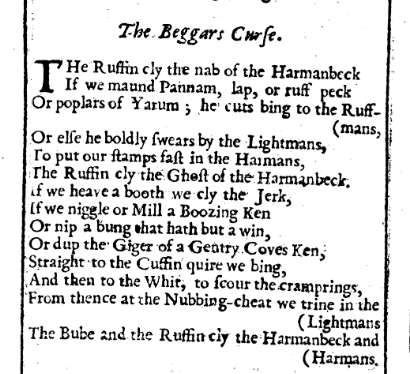
Using these strategies, you can try decoding a text below. Below is an excerpt drawn from The Canting Academy – a 17th century book about the criminal underworld. It is not written in Polari per se, but rather, a system of slang used by criminals and beggars. Nonetheless, the excerpt contains many words which are also found in Polari. The original is displayed below.

Let’s Translate!
Here, it should be noted that there is a translation provided in The Canting Academy. However, unlike what is suggested in the text, the translation is not word for word. It also is translated into 17th century English, which is not wholly understandable. By referring to dictionary entries and other sources, however, an accurate and modern-day translation can be done.
– Stage 1 –
To start, you will want to start by getting information on what the meaning of unfamiliar words in the excerpt are. Before doing this, keep in mind that the letters written as ‘ſ’ are not ‘f’. They are ‘s’ – e.g. ‘ſtamps’ is ‘stamps’.
From Polari dictionaries, you will probably find the following words: pannam (bread), stampers (legs – written as ‘stamps’ here), ken (house), and cheat (thing).
The Canting Academy also happens to have a glossary. It contains the following relevant terms:
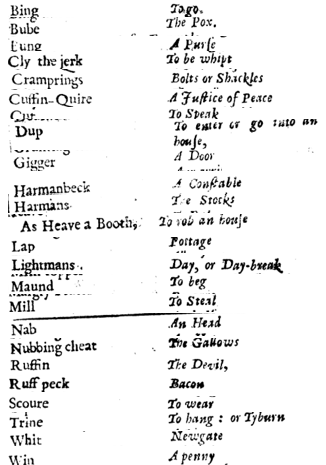
Bing: To go
Bube: The Pox
Bung: A purse
Cly the jerk: To be whipt
Cramprings: Bolts or Shackles
Cuffin-Quire: A Justice of Peace
Cut: To Speak
Dup: To enter or go into an house
Gigger: A Door
Harmanbeck: A Constable
Harmans: The Stocks
As Heave a Booth: To rob an house
Lap: Pottage
Lightmans: Day, or Day-break
Maund: To beg
Mill: To Steal
Nab: An Head
Nubbing cheat: The Gallows
Ruffin: The Devil
Ruff peck: Bacon
Scoure: To wear
Trine: To hang: or Tyburn
Whit: Newgate
Win: A penny
Many uncommon words are not included in the glossary. This is where you may want to use another source, such as Green’s Dictionary of Slang. According to Green’s Dictionary of Slang, the following words have the following meanings:
| Slang | English |
|---|---|
| Boozing | drinking |
| cly | to seize, get, take, steal |
| Gentry Cove | nobleman or gentleman |
| niggle | have sex |
| nip | cut a purse or pickpocket |
| poplars | porridge |
| Ruffmans | the woods or bushes |
| trine | hang |
| Yarum | milk |
You should now have all the words needed to successfully translate the excerpt. A word-for-word translation of the excerpt may leave you with something like what is written below.
The Devil took the head of the Constable,
If we beg for bread, pottage, or bacon,
Or milk porridge; he speaks to go to the woods,
Or else he boldly swears by the daytime,
To put our legs fast in the stocks.
The Devil took the ghost of the Constable.
If we rob a booth we get whipt.
If we have sex or break into a drinking house,
Or pickpocket a purse that hath but a penny,
Or enter the door of a gentleman’s house,
Straight to the Justice of Peace we go,
And then to Newgate, to wear the shackles,
From thence at the gallows we hang in the daytime,
The Pox and the Devil took the Constable and stocks.
– Phase 2 –
Now that you have all the relevant words, you need to make the sentences flow. At this stage, you will know the meanings of the words, but the words may have archaic spellings, the grammar may not make sense, and the intended meaning may not come across. You can go sentence-by-sentence to make the meaning of the excerpt clearer. See the table below.
| Word-for-Word | Intended Meaning | Notes |
|---|---|---|
| The Devil took the head of the Constable, | The Devil got into the Constable’s head | The excerpt talks of the Constable acting like the Devil – more likely to mean that the Devil controls/has influenced the Constable (as opposed to having decapitated the Constable). |
| If we beg for bread, pottage, or bacon, | If we beg for bread, soup, or bacon. | ‘Pottage’ is an archaic word for a type of soup. |
| Or milk porridge; he speaks to go to the woods, | Or milk porridge, he tells us to go to the woods | Whilst ‘cuts’ is noted to mean ‘speaks’, it is more likely that it means ‘tells’ in this context. |
| Or else he boldly swears by the daytime, | Or else he boldly swears by the daytime, | – |
| To put our legs fast in the stocks. | To put our legs firmly in the stocks. | ‘Fastly’ is an archaic term for ‘firmly’. |
| The Devil took the ghost of the Constable. | The Devil has seized the Constable’s soul | Again, the excerpt talks of the Constable acting like the Devil. ‘Ghost’ was also used in the past to refer to a soul. Putting these together, it is more likely that the sentence means that the Devil controls the Constable’s soul. |
| If we rob a house we get whipt. | If we rob a house, we get whipped. | ‘Whipt’ is an old spelling of ‘whipped’. |
| If we have sex or break into a drinking house, | If we have sex at or break into a pub, | Probably not referring to having sex in general being criminal – more likely to refer to having sex at a pub. ‘Pub’ is a more common term for ‘drinking house’. |
| Or pickpocket a purse that hath but a penny, | Or pickpocket a purse which has only a penny, | ‘That hath but a penny’ would be expressed as ‘which has only a penny’ in contemporary times. |
| Or enter the door of a gentleman’s house, | Or enter through the door of a gentleman’s house, | – |
| Straight to the Justice of Peace we go, | Straight to the Magistrate we go, | ‘Magistrate’ or ‘Judge’ is a more common term for ‘Justice of Peace’ in contemporary times. |
| And then to Newgate, to wear the shackles, | And then to Newgate, to wear the shackles, | – |
| From thence at the gallows we hang in the daytime, | From there at the gallows we hang in the daytime, | ‘There’ is the more common version of ‘thence’. |
| The Pox and the Devil took the Constable and stocks. | The plague and the Devil have the Constable and stocks. | The word ‘Bube’ probably refers to the bubonic plague. The word ‘have’ has been substituted in, to reflect the idea in the excerpt that the Constable and corporal punishment system is terrible and controlled by the Devil. |
Now, the excerpt has been fully translated. See the original version side-by-side with the translated version.

 Boyno Polari