Yiddish, spoken by around 11 million people across Europe prior to World War 2, consists of an amalgamation of different linguistic sources, not unlike Polari (Baker, 2002, p. 34). With Jewish people existing in England since at least the 11th century and a strong Yiddish-speaking community living in London from the 19th century, it is not surprising that some words in Polari are from Yiddish originally (Baker, 2002, p. 34; Roth, 1964, p. 4; Parkes, 1955, pp. 6-7). In this article, the history of Yiddish-speaking Jews (Ashkenazim) in England will be explored, before looking at how Yiddish came to influence Polari.
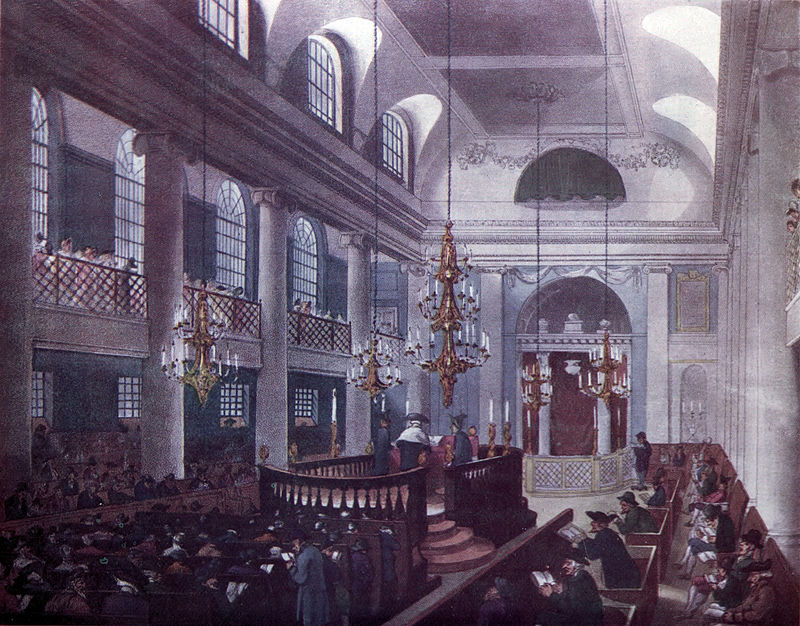
A Brief History of Jewish People in England
The history of Jewish people in England spans centuries, with the earliest Jewish presence in England believed to be in Norman England soon after the Norman Conquest (Roth, 1964, p. 4; Parkes, 1955, pp. 6-7). However, Jewish people were forcibly expelled in 1290 AD by Edward I, in which no significant Jewish community existed in England in subsequent decades (Roth, 1964, pp. 85 & 90; Parkes, 1955, p. 8). This was until the Spanish Inquisition of the late 15th century forced many Sephardic Jews to flee to Antwerp, of which some migrated soon after to London and Bristol (Parkes, 1955, p. 9). Jewish people were once again subject to expulsion, when Sephardic Jews in London were expelled in 1609 AD (Parkes, 1955, p. 9; Roth, 1964, p. 144). Nonetheless, a small Jewish community of mostly Sephardic descent re-established themselves, continuing to exist in an ambiguous legal environment in which their right to live in England was not explicitly recognised (Parkes, 1955, pp. 9-11).
Ashkenazi Jews likewise migrated to England at the same time that many Sephardic communities did (Parkes, 1955, p. 20). However, they initially constituted a small minority of Jewish migrants to England (Parkes, 1955, p. 20). It was not until the late 17th century that Ashkenazi Jews had begun to establish synagogues and cemeteries in London (Parkes, 1955, p. 21). Adding to the estimated 35000 Jews in England by 1871 according to Roth (1964, pp. 268-269) was a wave of immigration of Jews from Eastern Europe, many of whom would have been Yiddish-speaking. They came in the late 19th and early 20th centuries, fleeing from a rise in persecution in the Russian Empire (Roth, 1964, p. 269). Between 1883 and 1905, the estimated Jewish population of London increased from 47000 people to 150000 people (Roth, 1964, p. 270).
The Yiddish Influence on Polari
Out of the 250 terms that this site teaches, 11 (4.4% of all terms) have at least some suggestion of being from Yiddish. As Baker (2002, p. 34) notes, some of the Yiddish influences on Polari may be due to the presence of Ashkenazi Jews in the East End of London. As Yiddish theatre was well-known and popular in the 20th century, it is possible that performers who spoke Polari came into contact with the Yiddish language (Baker, 2002, p. 34). Furthermore, Baker (2002, p. 34) notes that people who were both Ashkenazi and homosexual could have contributed to the Yiddish influence on Polari.
Another answer to how Yiddish influenced Polari can likely be found by looking at the influence of Yiddish on the English language more broadly speaking. As Schultz (2019, p. 6) notes, many Yiddish loanwords in English exist primarily – for whatever reason – within informal language. It appears from this that certain terms in Polari (e.g. gonoff and meshigener, of which variants are indicated to be used in the English language) could have been adopted into English-language slang more broadly speaking before transferring to Polari. As well as this, Schultz (2019, p. 2) points out that there is a relatively high number of Yiddish loanwords in American English compared to other varieties of English. Baker (2002, pp. 34-35) writes that some American terms were adopted into Polari, which could potentially mean that some Yiddish loanwords came into Polari via American slang.
Conclusion
In conclusion, this article explores the centuries-old history of Jewish culture in England, as well as exploring how the presence of Jews in England (specifically the Ashkenazim) came to influence Polari. As seen above, it is possible that the Yiddish influence on Polari was due to direct contact between the Yiddish language and Polari-speakers. It is also possible that Yiddish-derived Polari terms were adopted via a third source, with American slang and the English language more broadly speaking being possibilities.
Sources
Baker, P. (2002). Polari – The Lost Language of Gay Men. Routledge.
Parkes, J. (1955). The History of the Anglo-Jewish Community. In M. Freedman (Ed.), A Minority in Britain (pp. 3-51). Vallentine, Mitchell & Co., LTD.
Roth, C. (1964). A History of the Jews in England (3rd ed.). Oxford University Press.
Schultz, J. (2019). The impact of Yiddish on the English language. English Today, 35(3), 2-7. https://doi.org/10.1017/S0266078418000494.
Image
Rowlandson, T., Pugin, A., Bluck, J., Stadler, J. C., Sutherland, T., Harraden, R. & Hill, J. (n.d.). [Great Synagogue of London Drawing]. Wikimedia Commons. https://commons.wikimedia.org/wiki/File:Microcosm_of_London_Plate_082_-_Synagogue,_Duke%27s_Place,_Houndsditch_(tone).jpg
 Boyno Polari
.jpg)
Leave a comment