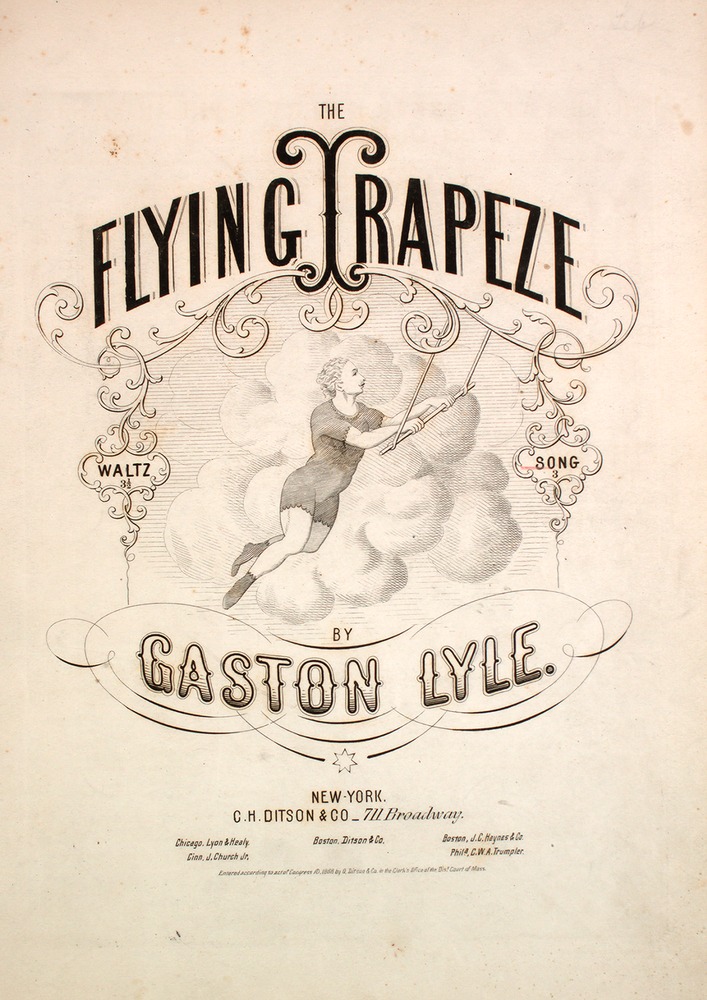
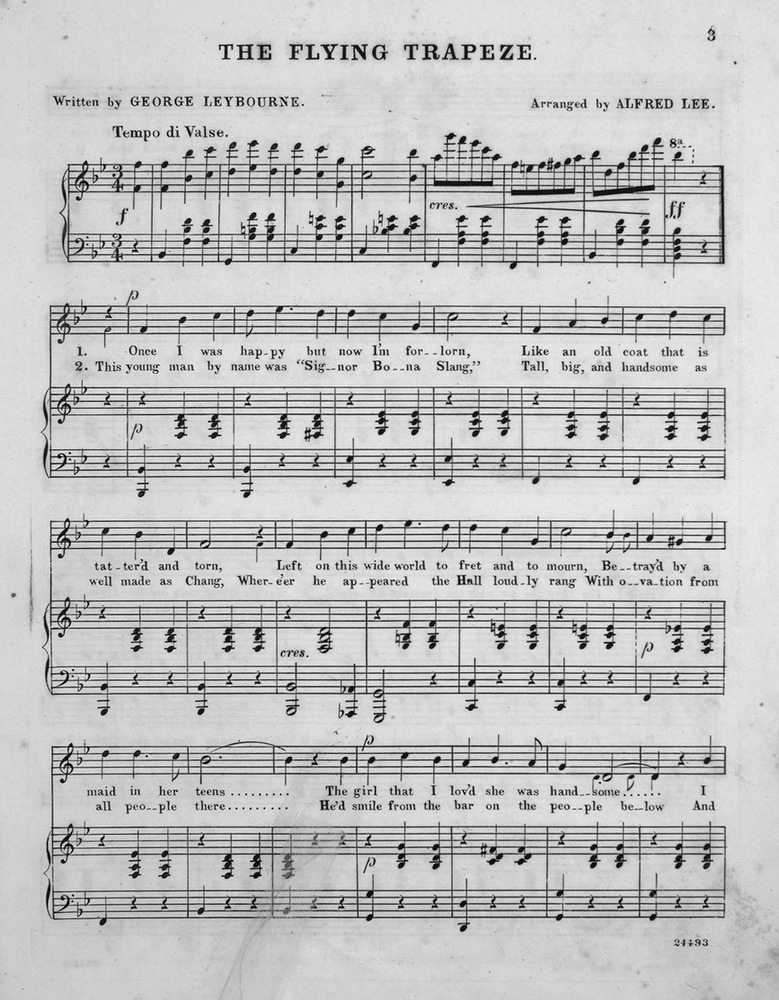
Written in 1868, The Flying Trapeze was a song about a man whose unrequited love chose to pursue a trapeze artist instead of him (Laybourne & Lee, 1868, pp. 3-5; Sheridan Libraries, n.d.). Despite only having one phrase (‘Signor Bona Slang’ – literally ‘sir good performance’) that could be described as Polari, it seemingly captures the broader context for those in the entertainment industry during the Victorian Era (Laybourne & Lee, 1868, p. 3). By extension, it also serves as an indication of the context in which Polari-speaking entertainers – a significant demographic of Polari-speakers at the time – operated in. For this reason, this article will deconstruct The Flying Trapeze with respect to the Victorian entertainment industry and the Victorian era as a whole. Specifically, three themes are apparent in the song: the rise of the music-hall genre and entertainment in general, the dangers of the entertainment industry to workers, and Victorian ideas regarding gender. These themes will be explored respectively after looking at the background of the song itself.
Background to The Flying Trapeze
The song was originally published in 1868, consisting of sheet music composed by George Leybourne and arranged by Alfred Lee (Sheridan Libraries, n.d.). It was inspired by a flying trapeze artist by the name of Jules Leotard, who was not only considered an extraordinary trapeze artist, but also the pioneer of the flying trapeze as a form of entertainment (Holmes, 2023, p. 282; Hartnoll & Found, 1992, p. 335).
It is unclear if the story depicted in the song is based on real events or is partially fictional. Nonetheless, the song follows the plight of a man who feels inadequate in comparison to a trapeze artist by the name of ‘Signor Bona Slang’ (Laybourne & Lee, 1868, pp. 3-5). Being captivated by the performance skills of ‘Signor Bona Slang’, a woman who the protagonist wishes to marry (or potentially a girl as she is disturbingly described as being in her ‘teens’) decides to pursue ‘Signor Bona Slang’ instead of him (Laybourne & Lee, 1868, pp. 3-5). She then eventually becomes a trapeze artist herself (Laybourne & Lee, 1868, p. 5).
The Rise of the Music-Hall Genre
Brought about by the Industrial Revolution, the Victorian era saw a rise in disposable income, a rise in spare time, and more advanced rail networks, meaning that the masses were able to travel to see performances with relative ease (Farge, 2021). Aside from the increasing popularity of circuses and funfairs, the genre of entertainment that The Flying Trapeze is related to – called ‘music-hall’ – also gained its prominence during this time (Hartnoll & Found, 1992, p. 334; Farge, 2021). Originally being a form of musical entertainment which took place in taverns and featured singers, comedians, acrobats and jugglers, designated places for the music-hall genre began to be built across England (Hartnoll & Found, 1992, pp. 334-335). This included the Alhambra Music Hall, which was amongst the various locations Jules Leotard performed (Holmes, 2023, pp. 284-285). With The Flying Trapeze being composed by a music hall artist (George Laybourne) and having its story based around a music-hall performer, the song symbolises the existence of the music-hall genre and the rise of entertainment in general, not long after a time period in which the pursuit of entertainment was considered a relative rarity (Hartnoll & Found, 1992, pp. 334-335; Farge, 2021).
The Dangers of the Entertainment Industry
In the context the song was written, the description of ‘Signor Bona Slang’ being ‘daring’ was seemingly in reference to the risk of death more than anything (Holmes, 2023, pp. 287 & 291; Laybourne & Lee, 1868, pp. 3-4). In contrast to contemporary times whereby occupational health and safety legislation is the norm (at least in the United Kingdom), Jules Leotard’s first London performance at the Alhambra Music Hall in 1861 did not involve safety nets (Holmes, 2023, p. 283). Instead, the only apparent safety measure against a fall was the raised platform he performed above being covered in sawdust and carpets (Holmes, 2023, p. 283). It was performances during this time in which the possibility of a performer’s death in fact provided a thrill to audience members, contributing to both their popularity and denunciation at the time (Holmes, 2023, pp. 286-287). In this sense, the song in its description of ‘Signor Bona Slang’ as ‘daring’ arguably reflects not only the lack of physical protections for trapeze artists at the time, but also the nature of consumer demand in the industry which compelled him to perform in unsafe conditions (Laybourne & Lee, 1868, pp. 3-4; Holmes, 2023, pp. 288-289).

Victorian Ideas Regarding Gender
The song contains several overtly gendered assumptions. In particular, the belief that being a trapeze artist was a distinctly masculine occupation is captured by the line, ‘you’d think her a man on the flying trapeze’ (Leybourne & Lee, 1868, p. 4). This is arguably a reflection of gender roles in Victorian society. Alongside marriage being considered a necessity at the time, women would be placed under a sort of guardianship system whereby they would lose rights over their own property and wages and be unable to enter contracts once married (Caine, 1982, pp. 542). They were in turn expected to support their husband and children in the home (Caine, 1982, p. 540). This societal norm was upheld by a belief that women inherently possessed a gentle nature (Caine, 1982, p. 540; Holmes, 2023, p. 292). As such, the involvement of women either partaking in or viewing the life-threatening acts of trapeze artists was considered a perversion of a women’s natural instincts (Holmes, 2023, p.292). For this reason, not only would trapeze artistry have contradicted a woman’s domestic duties, but it was also an act which was viewed as contrary to a woman’s nature.
Despite this, it appears that the music-hall genre was relatively progressive compared to broader society in one regard. In what was rare in entertainment at the time, early music-hall was known to employ female singers and comedians (Hartnoll & Found, 1992, p. 335). However, the ‘you’d think her a man’ line of The Flying Trapeze indicates that this permissiveness may have nonetheless had limitations (Laybourne & Lee, 1868, p. 4).
Conclusion
The Flying Trapeze potentially serves as a testament to the context in which Polari-speakers in the entertainment industry (particularly the music-hall genre) operated. As it can be seen through the song, the British music-hall genre and the entertainment industry in general was marked by its emergence after a period of relatively few entertainment opportunities, a lack of physical protections for workers, and a clearly gendered dimension to its operations.
Sources
Caine, B. (1982). Feminism, Suffrage and the Nineteenth-Century English Women’s Movement. In E. Sarah (Ed.), Reassessments of ‘First Wave’ Feminism (pp. 537-550). Pergamon Press.
Farge, H. (2021, June 22). The language of the fairground community: secrets of Parlyaree. University of Sheffield. https://www.sheffield.ac.uk/library/news/language-fairground-community-secrets-parlyaree
Hartnoll, P. & Found, P. (Eds.). (1992). The Concise Oxford Companion to the Theatre. Oxford University Press.
Holmes, K. (2023). Experiencing Léotard’s Sensational Body: Risk, Morality and Pleasure above the British Stage. Journal of Victorian Culture, 28(2), 282-301. https://doi.org/10.1093/jvcult/vcac071
Laybourne, G. & Lee, A. (1868). The Flying Trapeze. C. H. Ditson & Co.
Sheridan Libraries. (n.d.). The flying trapeze. John Hopkins University. https://levysheetmusic.mse.jhu.edu/collection/103/073
Videos and Images
Enright, R. (1934). Twenty Million Sweethearts. Warner Brothers.
Laybourne, G. & Lee, A. (1868). The Flying Trapeze. C. H. Ditson & Co.
Watkins, F. (1874). [An engraving of the Alhambra Music Hall in London]. Wikimedia Commons. https://commons.wikimedia.org/wiki/File:Leicester_Square_with_the_Alhambra_formerly_the_Royal_Panopticon_ILN_1874.jpg.
 Boyno Polari

Leave a comment