It is said that many terms in Polari trace back to Standard Italian (which in this article will be referred to as simply ‘Italian’) (Collins, cited in Farge, 2021). Whilst it is undeniable that there is a strong Italian influence on Polari, it is likely that other Romance languages (both standardised and non-standardised) also exerted influences on Polari. Within historical literature, this can be seen for two reasons. Firstly, regarding influences from Italy specifically, Standard Italian was understood by only a minority of what is now known as Italy when Italian migrants were said to influence Polari in the 19th century (Farge, 2021; Kinder & Colombo, 2012, pp. 109-112). Secondly, Polari is believed to have been influenced by Sabir (a mixed language spoken in the Mediterranean), which itself was influenced by multiple Romance languages spoken in the region (Operstein, 2017, p. 60-61). Aside from historical information, however, it is also possible to see the varied influences on Polari through the phonology of the words themselves. In this article, the phonology of four Italo-Polari1 terms (‘bona’, ‘dooey’, ‘nochy’ and ‘mangarry’) will be compared to various Romance languages. Whilst these comparisons are not intended to provide an etymology of these terms, they – alongside historical information – arguably support the notion that the influence of Romance languages on Polari is diverse and multifaceted, including both standardised and non-standardised languages.
Below is map which shows the Romance languages selected for this article, as well as their approximate locations.
Comparing the Dialects
Below is a table comparing the IPA transcriptions2 for the word ‘bona’ (‘good’) as it appears in the phrase ‘good night’.
| Language | IPA for ‘good’ |
|---|---|
| Polari | /ˈbəʊnə/ |
| Portuguese | /bõ/ |
| Spanish | /bwenas/ |
| Catalan | /bɔna/ |
| French | /bɔn/ |
| Ligurian | /ˈbuŋˑa/ |
| Italian | /ˈbwɔna/ |
| Venetian | /bɔna/ |
| Romanian | /ˈbunə/ |
As can be seen above, there are noticeable differences in how these words are pronounced, with many either strongly or barely resembling the Polari IPA transcription. Interestingly, the /w/ present in the standard Italian IPA term does not appear in Polari, whereas all other languages apart from Spanish do not have the /w/ to begin with. Another interesting feature is that none of the non-Polari terms present above have the /əʊ/ sound present in Polari. This is potentially related to the fact that /o/ sound in Italian tends to be adapted to /əʊ/ in English, particularly when the sound is at the end of a word. Take the following examples.
/ˈpjano/ —> /piːˈænəʊ/ Piano
/ˈɡetto/ —> /ˈɡɛtəʊ/ Ghetto
Source: (Collins, n.d.)
Whilst the Polari term /ˈbəʊnə/ has the /ə/ sound at the end, this is likely to also be a phonological adaptation, as only Romanian (which is unlikely to have influenced Polari at all) also has this sound at the end of the word. Furthermore, Standard Italian doesn’t have an /ə/ sound, which potentially means that surrounding languages like Ligurian and Venetian likewise do not.
Assuming that the /əʊ/ and /ə/ sounds present in the Polari term ‘bona’ were the result of phonological adaptation and that the consonant sounds remained the same when being adopted into Polari, it is possible that the term was derived from either Catalan or Venetian (or languages similar to these two languages).
Below is a table comparing the IPA transcriptions for the word ‘two’ as a cardinal number.
| Language | IPA for ‘two’ |
|---|---|
| Polari | /ˈdu:i/ |
| Portuguese | /dojs/ |
| Spanish | /dos/ |
| Catalan | /dos/ |
| French | /dø/ |
| Ligurian | /ˈduːe/ |
| Italian | /ˈdue/ |
| Venetian | /dɔːe/ |
| Romanian | /dowə/ |
In the graph above, a sort of ‘east-west’ divide can be seen. In Portuguese, Spanish and Catalan, the final IPA symbol is /s/, whereas the final symbol in all other languages is a vowel sound.
In this case, Italian and Ligurian appear to have the same /ˈdu/ sound present in Polari. However, they both end with an /e/ as opposed to the /i/ found in Polari, which may be due to a phonological adaptation when the word was adopted. Distinguishing the Ligurian term from the Italian term is the long /uː/ which is also present in Polari. In this case, the Ligurian /ˈduːe/ arguably bears the most resemblance to the Polari /ˈdu:i/.
Below is a table comparing the IPA transcriptions for the word ‘night’.
| Language | IPA for ‘night’ |
|---|---|
| Polari | /nɒtʃi/ |
| Portuguese | /ˈnojtʃi/ |
| Spanish | /ˈnotʃe/ |
| Catalan | /nit/ |
| French | /nɥi/ |
| Ligurian | /ˈnøtˑe/ |
| Italian | /ˈnɔtte/ |
| Venetian | /ˈnɔtˑe/ |
| Romanian | /ˈnwapte/ |
Here, the /tʃ/ sound which is present in Polari only appears to be present in Spanish and Portuguese. However, both the Spanish and Portuguese versions of ‘night’ contain symbols which do not appear in the Polari /nɒtʃi/. Specifically, putting aside both of them having a /o/ in place of an /ɒ/, the Spanish term has a /e/ instead of an /i/ at the end of the word, and the Portuguese term has a /j/ present for the /tʃ/ sound.
That being said, the Spanish and Portuguese terms resemble the Polari term ‘nochy’ relatively well compared to the other languages in this article.
The final term is ‘mangarry’. Below is a table comparing the IPA transcriptions for the word ‘eat’.
| Language | IPA for ‘eat’ |
|---|---|
| Polari | /mənˈdʒaːri/ |
| Portuguese | /koˈmer/ |
| Spanish | /koˈmer/ |
| Catalan | /menˈdʒa/ |
| French | /mɑ̃ʒe/ |
| Ligurian | /maŋˈdʒaː/ |
| Italian | /manˈdʒare/ |
| Venetian | /manja/ |
| Romanian | /mɨnˈka/ |
In this case, there again appears to be a sort of ‘east-west divide’, with Portuguese and Spanish using what appears to be entirely different terms for ‘eat’.
One feature which only appears in both Italian and Polari is the addition of /r/ followed by a vowel sound after the vowel following either a /ʒ/, a /j/ or a /k/. Overall, the Italian term appears to represent the Polari term most closely. Other than a few minor vowel changes, the term appears remarkably similar with the consonants being the same in both terms.
Conclusion
Phonologically speaking, the four Polari terms in this article bear similarities to multiple Romance languages, such as Spanish, Portuguese, Ligurian and Catalan. As stated previously, this article does not intend to suggest where these Polari terms derive from. Rather, by comparing the phonology of these terms to various Romance languages, it appears that Italo-Polari terms broadly speaking are unlikely to be derived from only one single Romance language, but rather, from multiple sources. As seen above, these sources may include non-standard varieties, in addition to standardised Romance languages.
- ‘Italo-Polari’ is used in this article to refer to terms in Polari which are believed to derive from Italian or other Romance languages. ↩︎
- Some IPA transcriptions have been transcribed directly from singular audio recordings, particularly for Venetian and Catalan. Whilst due care has been taken to ensure these recordings are accurate, there may be minor errors. ↩︎
Sources
Baker, P. (2002). Polari – The Lost Language of Gay Men. Routledge.
Brunelli, M. [michele brunelli]. (2016, February 15). veneto useful venetian phrases vid . Youtube. https://www.youtube.com/watch?v=J22EOez0qjo&t=50s
Collins. (n.d.). bom. Collins Dictionary. https://www.collinsdictionary.com/dictionary/portuguese-english/bom
Collins. (n.d.). bonne. Collins Dictionary. https://www.collinsdictionary.com/dictionary/french-english/bonne
Collins. (n.d.). bueno. Collins Dictionary. https://www.collinsdictionary.com/dictionary/spanish-english/bueno
Collins. (n.d.). buono. Collins Dictionary. https://www.collinsdictionary.com/dictionary/italian-english/buono
Collins. (n.d.). comer. Collins Dictionary. https://www.collinsdictionary.com/dictionary/portuguese-english/comer
Collins. (n.d.). comer. Collins Dictionary. https://www.collinsdictionary.com/dictionary/spanish-english/comer
Collins. (n.d.). deux. Collins Dictionary. https://www.collinsdictionary.com/dictionary/french-english/deux
Collins. (n.d.). dois. Collins Dictionary. https://www.collinsdictionary.com/dictionary/portuguese-english/dois
Collins. (n.d.). dos. Collins Dictionary. https://www.collinsdictionary.com/dictionary/spanish-english/dos
Collins. (n.d.). due. Collins Dictionary. https://www.collinsdictionary.com/dictionary/italian-english/due
Collins. (n.d.). ghetto. Collins Dictionary. https://www.collinsdictionary.com/dictionary/italian-english/ghetto
Collins. (n.d.). mangiare. Collins Dictionary. https://www.collinsdictionary.com/dictionary/italian-english/mangiare
Collins. (n.d.). manger. Collins Dictionary. https://www.collinsdictionary.com/dictionary/french-english/manger
Collins. (n.d.). noche. Collins Dictionary. https://www.collinsdictionary.com/dictionary/spanish-english/noche
Collins. (n.d.). noite. Collins Dictionary. https://www.collinsdictionary.com/dictionary/portuguese-english/noite
Collins. (n.d.). notte. Collins Dictionary. https://www.collinsdictionary.com/dictionary/italian-english/notte
Collins. (n.d.). nui. Collins Dictionary. https://www.collinsdictionary.com/dictionary/french-english/nui
Collins. (n.d.). piano. Collins Dictionary. https://www.collinsdictionary.com/dictionary/italian-english/piano
Council for Ligurian Linguistic Heritage. (n.d.). buona. https://conseggio-ligure.org/en/dictionary/deize/buona/
Council for Ligurian Linguistic Heritage. (n.d.). due. https://conseggio-ligure.org/en/dictionary/deize/due/
Council for Ligurian Linguistic Heritage. (n.d.). mangiare. https://conseggio-ligure.org/en/dictionary/deize/mangiare/
Council for Ligurian Linguistic Heritage. (n.d.). notte. https://conseggio-ligure.org/en/dictionary/deize/notte/
Easy Catalan. [Easy Catalan]. (2023, March 15). Food in Catalonia: Vocab You Must Know | Super Easy Catalan 18 . Youtube. https://www.youtube.com/watch?v=nXvIr3U2IRQ&t=134s
Easy Catalan. [Easy Catalan]. (2023, January 25). How to introduce yourself in Catalan? | Super Easy Catalan 16 . Youtube. https://www.youtube.com/watch?v=PCqYN4Fu0t8&t=128s
Easy Languages. [Easy Languages]. (2019, May 7). Numbers in Catalan | Super Easy Catalan 4. Youtube. https://www.youtube.com/watch?v=mm88lK_Msb0&t=32s
Farge, H. (2021, June 22). The language of the fairground community: secrets of Parlyaree. University of Sheffield. https://www.sheffield.ac.uk/library/news/language-fairground-community-secrets-parlyaree
Kinder, J. J. & Colombo, M. (2012). Italian as a Language of Communication in Nineteenth Century Italy and Abroad. Italica, 89(1), 109-121. https://www.jstor.org/stable/41440499
Miroiu, M. (1996). Romanian-English, English-Romanian dictionary. Hippocrene Books.
Operstein, N. (2017). Toward a typological profile of Lingua Franca: A view from the lexicon and word formation. Language Sciences, 66, 60-82. https://doi.org/10.1016/j.langsci.2017.12.007
Wierzbicki, N. [Ecolinguist]. (2022, May 24). Venetian Language | Can Portuguese, Romanian and French speakers understand it?. Youtube. https://www.youtube.com/watch?v=QxW37R57kq8&t=431s
Wierzbicki, N. [Ecolinguist]. (2020, June 16). Dialect of Venetian | Can Spanish, Catalan, and Portuguese speakers understand it? | #1. Youtube. https://www.youtube.com/watch?v=yfxiSpQrmu8&t=300s
Images
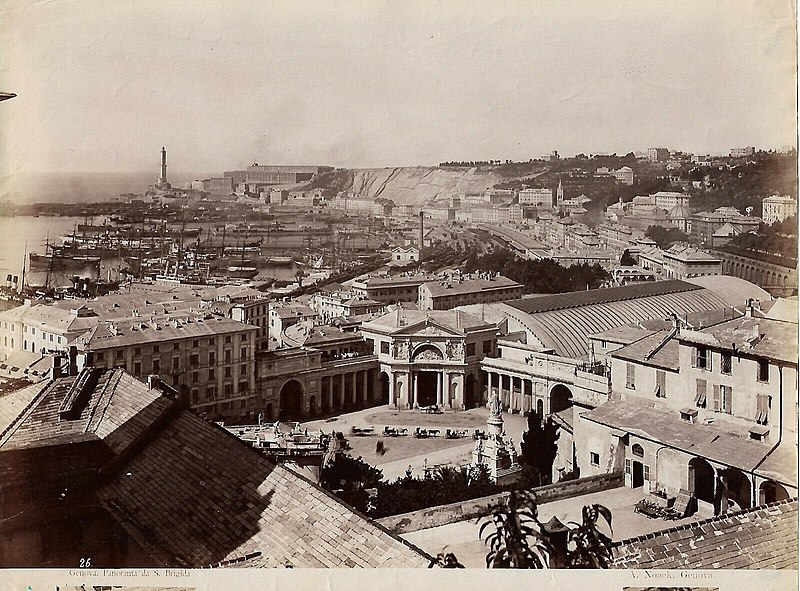
Noack, A. (n.d.). Genoa: Panorama da S. Brigida [photograph]. Wikimedia Commons. https://commons.wikimedia.org/wiki/File:Noack,_Alfred_(1833-1895)_-_n._0026_-_Genova_-_Panorama_da_S._Brigida.jpg
 Boyno Polari
_-_n._0026_-_Genova_-_Panorama_da_S._Brigida.jpg)
Leave a comment