Romani people have often lived on the outskirts of wider society in Britain, not unlike travelling showpeople and homosexual men whose history has been explored in previous posts. It would thus seem natural that Polari would have absorbed at least some Romani words. However, there is contention as to what extent the Romani language influenced Polari. On the one hand, some scholars such as Farge (2021) imply that Romani forms a significant source of vocabulary in Polari. However, others such as Baker (2002, pp. 31-32) claim that the Romani influence on Polari is insignificant. Whilst this article will make no attempt to resolve these polarities, an overview of the history of Romani people as well as the nature of potential Romani influences within Polari will be explored.
Romani People and Language
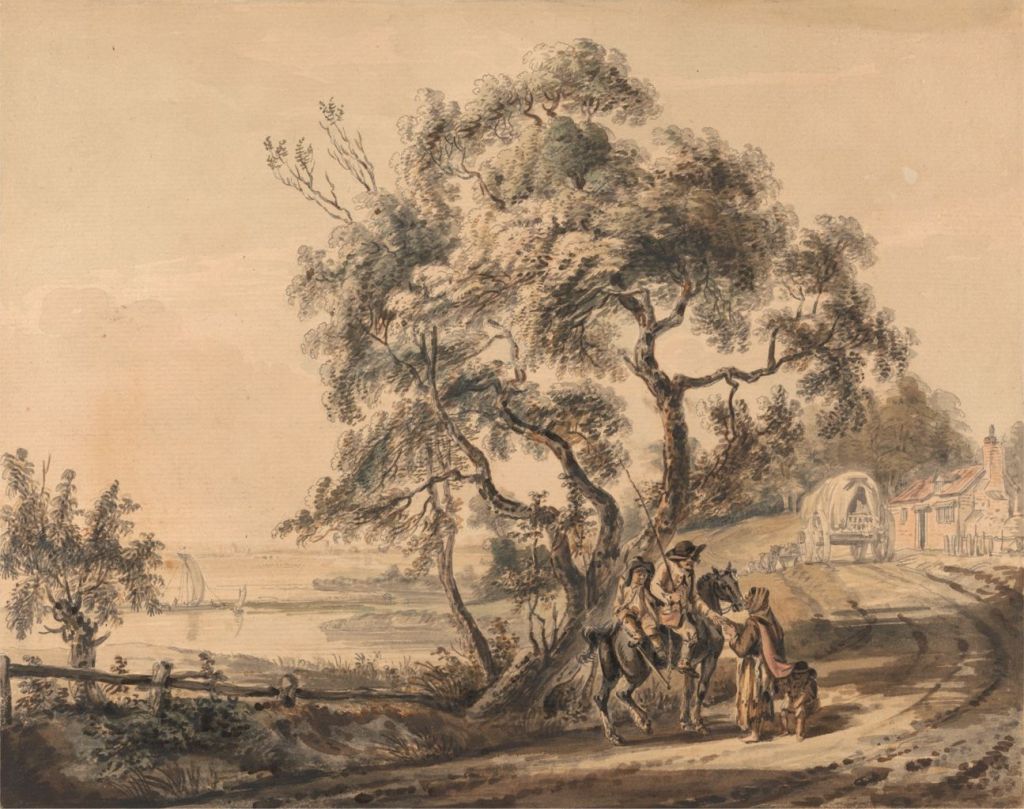
Romani people are believed to have first arrived in Britain in the late 15th or early 16th century, having ultimately originated from India before travelling into Continental Europe (Matras, 2010, p. 1; Richardson & Ryder, 2012, pp. 5-6). Though initially welcomed, their itinerant lifestyle, connotations of vagrancy, and traditional occupations such as palmistry and fortune telling (which stood in contrast to Christian traditions in England) caused friction between Romani people and wider society (Richardson & Ryder, 2012, pp. 5-6; Rabin, 2017, p. 35). Soon after their arrival in 1530, they were subject to legislation which sought to have them banished from England (Richardson & Ryder, 2012, p. 6; Rabin, 2017, p. 35). However, this order was ultimately replaced by 1562, in which being Romani was no longer an offense subject to banishment as long as any given Romani person abandoned their traditionally itinerant lifestyle (Richardson & Ryder, 2012, p. 6). Expulsions of Romani people no longer took place by the late 16th century (Rabin, 2017, p. 35). However, Romani people continued to face legislation which threatened their traditional way of life, including the Turnpike Act of 1822, which prohibited roadside camping (Richardson & Ryder, 2012, p. 6). Throughout history, Romani people in England – much like homosexual men and to a lesser extent travelling showpeople – have been associated with criminality and a perceived incompatibility with wider society (Richardson & Ryder, 2012, p. 11).
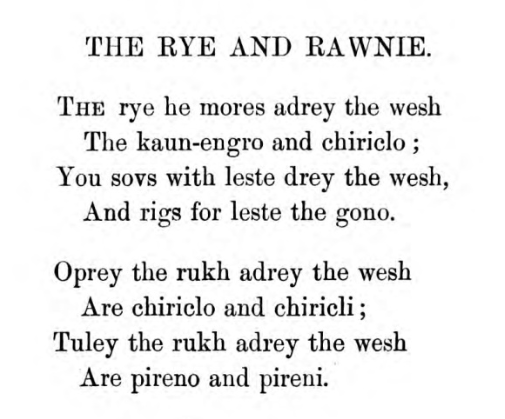
Having originated in South Asia, Romani languages resemble Indo-Aryan languages such as Hindi and Gujarati (Matras, 2010, pp. 31-32). In addition to this, a significant grammatical and lexical influence from Greek as well as loanwords from Farsi and Armenian are observable (Matras, 2010, pp. 34-37). Romani people in England used to speak a form of Romani which had grammar and phonology which differed from that of the English language (Matras, 2010, p. xi; Baker, 2002, p. 31). However, from the late 19th century, it came to resemble a mixed language consisting of English grammar and phonology, alongside a mixed lexis of Romani and English words (Matras, 2010, p. xi; Baker, 2002, p. 31). Much like how Polari functioned, Romani languages supposedly sometimes function as a means of preventing outsiders from understanding what is being said (Matras, 2010, pp. 23-24; Baker, 2002, p. 32).
Romani Influence on Polari
Out of the 250 terms this site teaches, 17 (or 6.8% of all terms) have at least some indication of being from Romani. These terms include ‘cove’, ‘ken’, ‘charver’, ‘gaff’, ‘bosh’, ‘caroon’, ‘chavy’, ‘parnie’, ‘rozzer’, ‘varda’, ‘vardo’, ‘zhoosh’, ‘lau’, ‘lav’, ‘lell’, ‘gajo’ and ‘tober’. That being said, many of these 17 terms are merely inferred to be related to Romani and may not be from Romani in reality, meaning that the origins of these words are not definitive. As Baker (2002, p. 32) writes, it is also plausible that terms which are similar between Angloromani and Polari may be the result of borrowing from a third language. Therefore, it remains unclear as to what extent words originating from Romani exist in Polari.
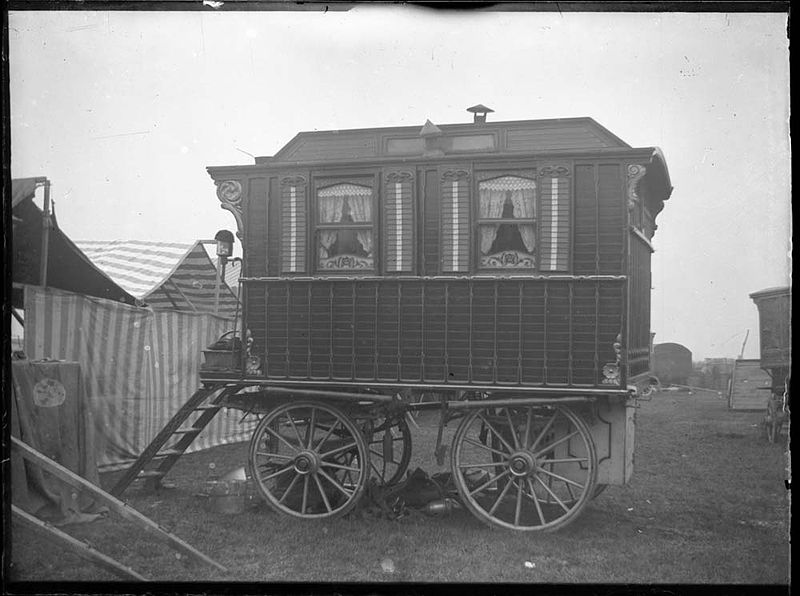
From an anthropological perspective, travelling showpeople (amongst whom Polari was spoken) bear noticeable similarities to Romani people (Carmeli, 1988, p. 259). Apart from traditionally being itinerant and travelling in caravans (though often for different reasons), some Romani people worked in entertainment not unlike travelling showpeople (Carmeli, 1988, pp. 259 & 275-276). This would suggest at least some interaction between Romani people and travelling showpeople, which could have also resulted in some degree of linguistic contact. However, the extent to which these two groups interacted is nonetheless unclear.
Conclusion
The history of British Romani people is centuries old. Originating in South Asia, the Romani people have faced a significant level of stigmatisation during their centuries of presence in Britain, supposedly having historical and linguistic connections to people such as homosexual men and travelling showpeople who used Polari. Despite this, the history of Romani people in relation to Polari remains ambiguous. Whilst a number of Polari terms have supposedly Romani origins, many of these supposed origins are not strongly supported. Furthermore, whilst there appears to be historical analogues between Romani people and the people who historically used Polari (such as nomadism, work in the entertainment industry and persecution), it is unclear to what extent Romani people and Polari-speakers interacted. Therefore, more research is needed on the topic.
Sources
Baker, P. (2002). Polari – The Lost Language of Gay Men. Routledge.
Carmeli, Y. S. (1988). Travelling circus: an interpretation. European Journal of Sociology, 29(2), 258-282. https://www.jstor.org/stable/24467560
Farge, H. (2021, June 22). The language of the fairground community: secrets of Parlyaree. University of Sheffield. https://www.sheffield.ac.uk/library/news/language-fairground-community-secrets-parlyaree
Green, J. (n.d.). Green’s Dictionary of Slang. https://greensdictofslang.com/
Matras, Y. (2010). Romani in Britain: The Afterlife of a Language. Edinburgh University Press.
Rabin, D. Y. (2017). Britain and its internal others, 1750–1800. Manchester University Press. https://doi.org/10.7765/9781526120410
Richardson, J. & Ryder, A. (2012). Setting the context: Gypsies and Travellers in British
society. In J. Richardson & A. Ryder (Eds.), Gypsies and Travellers: Empowerment and Inclusion in British Society (pp. 3-20). Bristol University Press. https://muse-jhu-edu.ap1.proxy.openathens.net/book/79718
Images
Borrow, G. (1874). Romano Lavo-Lil. William Clowes and Sons. https://hdl.handle.net/2027/wu.89098050875
Fenwick, A. J. (n.d.). [Photo of showman’s caravan]. Wikimedia Commons. https://commons.wikimedia.org/wiki/File:Circus_Showman%27s_caravan2.jpg. Held by Tyne & Wear Archives & Museums.
Sandby, P. (n.d.). The Gypsy Fortune-Teller. [watercolour and graphite drawing]. Yale Center for British Art. https://collections.britishart.yale.edu/catalog/tms:15079
 Boyno Polari

Leave a comment