Linguist Paul Baker (cited in Brougham, 2016) described his research on the version of Polari used by gay men as a ‘race against time’, with some Polari-speakers who he interviewed for his 2002 PhD dissertation unfortunately passing away only weeks after being interviewed. With Polari being more of a historical oddity as opposed to a facet of everyday life for LGBT people in contemporary Britain, it raises the question as to how Polari declined. For this reason, this article will provide an overview of the cultural factors which contributed to Polari’s decline. Drawing on David Crystal’s theory on the cultural causes of language death in his 2000 book titled Language Death and Paul Baker’s 2002 PhD dissertation titled Polari – The Lost Language of Gay Men, two ‘stages’ of Polari’s decline will be explored. This will be after comparing how the decline of a system of slang like Polari differs from the decline of fully-fledged natural languages.
The Decline of Polari Vs Natural Language Decline
This article uses Crystal’s (2000, pp. 68-90) theory on the cultural causes of language death – namely that languages can die due to cultural factors which manifest in three stages. However, it should be noted that this theory deals with fully-fledged languages rather than Polari, which is not a fully-fledged language (Crystal, 2000, p. 68-90; Baker, cited in Brougham, 2016). It thus becomes essential to define where Crystal’s theory is relevant to Polari’s decline and where it isn’t. The process by which languages decline through cultural means is paraphrased from Crystal (2000, pp. 76-79) below:
- Stage 1: Immense Pressure to Abandon the Language
- Can be economic pressure, social pressure, or political pressure (Crystal, 2000, p. 78).
- These pressures may be caused by events like mass migration, the centralisation of political power to members of specific linguistic groups, and monolingual media (Crystal, 2000, pp. 77-78).
- The pressure can be the result of government policies (i.e., ‘top-down’), arise from the cultural values of everyday people (i.e., ‘bottom-up’), or from any other source (Crystal, 2000, pp. 78-79).
- Stage 2: Bilingualism
- People retain knowledge of their old language, but increasingly prefer to use a new language (Crystal, 2000, p. 79).
- Stage 3: Irrelevance Amongst Younger Generations
- Parents stop using the old language with their children, with the use of the old language being stigmatised (Crystal, 2000, p. 79).
- Younger generations see the old language as irrelevant and identify more with the new language, failing to use the old language in wider society (Crystal, 2000, p. 79).
This three-stage model has a number of limitations when describing the decline of Polari. Whilst stage one – immense pressure to abandon a language – would apply to Polari, stage two – bilingualism – appears irrelevant given that the nature of anti-languages like Polari is that they are inherently built upon an existing language and are designed to be spoken in addition to one’s mother tongue (Baker, 2002, pp. 13-14; Crystal, 2000, pp. 78-79). To describe bilingualism in the sense of speaking two language varieties as a stage of language decline therefore doesn’t seem applicable to Polari. The third stage – irrelevance to younger generations – could be applicable to Polari (Crystal, 2000, pp. 78-79). However, Crystal (2000, p. 79) characterises this stage as being due to a lack of a given language’s use within family settings and wider society, which were two domains that Polari was generally not used to begin with. The variety of Polari used by gay men was historically not acquired through parental figures and wider society (Baker, cited in Brougham, 2016). Instead, it was taught by older gay men to younger gay men within the confines of gay subcultures, without contributions from familial figures and wider society (Baker, cited in Brougham, 2016). In this sense, stage 3 of Crystal’s theory only applies when viewing irrelevance amongst younger generations in the broadest possible sense, taking into account systems of slang which cease to be transmitted within the confines of subcultures.
Assuming that Crystal’s theory can be applied to Polari albeit in a modified form, this article proposes that Polari went through two stages – immense pressure to abandon Polari, and a lack of relevance of Polari to younger generations of gay men. Below, these stages will each be explored respectively.
Immense Pressure to Abandon Polari – Stage 1
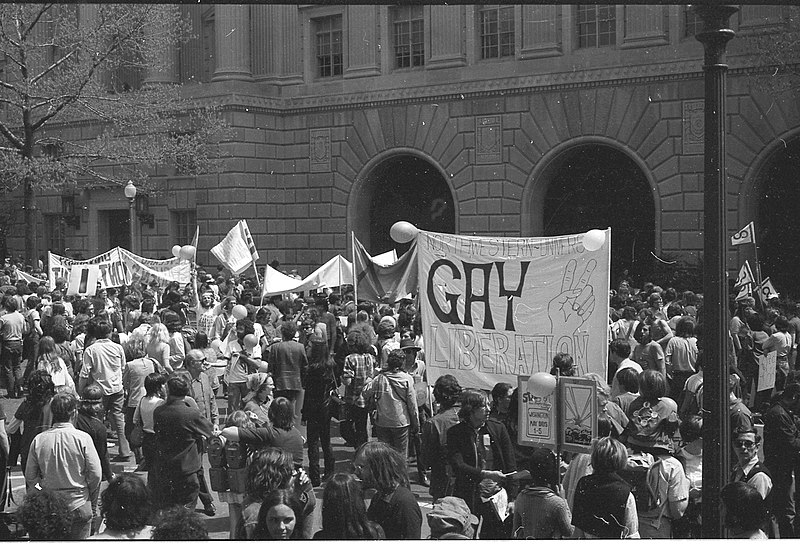
As Baker (2002, pp. 115-120) notes, the rise of the Gay Liberation Movement saw the denunciation of effeminate homosexuality which was by extension associated with Polari. According to Baker (2002, pp. 115-121), the reasons for the denunciation of effeminacy were varied and included the idea that the differentiation of masculine and effeminate gay men was a reflection of heteronormativity, that effeminate gay men were unattractive, that effeminacy was a hindrance to broader societal acceptance, and that effeminate men were contrary to the image of political power desired by gay liberationists. Polari was likewise associated with effeminacy and denounced, being associated with the ghettoisation of homosexuals as opposed to the assimilation to – and thus respect from – broader society (Baker, 2002, pp. 118-119).
Apart from the denunciation of effeminate homosexuality was the view that Polari was misogynistic and racist (Baker, 2002, p. 119). Putting aside the existence of Polari terms like ‘fag hag’ to describe women who are friends with gay men, ‘schvartza’ to describe people of African descent, and a ‘Jew’s eye’ to describe ‘anything of value’, the fact that Polari had a distinctly feminine quality to it and was used by men led many to believe that its use essentially mocked women (Baker, 2002, pp. 119, 174, 178 & 189).
Irrelevance Amongst Younger Generations – Stage 2
With homosexual acts between men over the age of 21 in private being decriminalised in England and Wales in 1967, Polari became relatively redundant as a means of avoiding prosecution (Baker, 2002, pp. 113-115). Likewise, Julian and Sandy (a radio show) had exposed the broader populace to Polari, weakening its secrecy (Baker, 2002, pp. 111-113). This coincided with the era of the Gay Liberation Movement shortly after, with many gay people wanting to be as ‘open as possible’ about their sexual orientation (Baker, 2002, p. 115). The nature of gay culture in America – which emphasised conventionally masculine men who were expressive of their sexuality – arguably had an influence on this (Baker, 2002, pp. 121-123). The need for a language of secrecy amongst gay men in Britain thus became significantly weaker for future generations of gay men (Baker, 2002, pp. 113 & 115)
Compounding this was a divide between older generations of gay men (many of whom knew Polari) and younger generations (who were influenced by gay liberation politics, masculine ideals, and American gay culture) (Baker, 2002, p. 121). Specifically, Baker (2002, pp. 120-121) notes that younger gay men viewed older gay men as ‘unfashionable’, ‘unattractive’ and effeminate, and hence generally avoided associating with them. This meant that Polari – whose main method of acquisition was through older gay men teaching younger gay men – was no longer being acquired by younger generations, meaning that it lost its relevance (Baker, 2002, p. 121; Baker, cited in Brougham, 2016).
Conclusion
This article – drawing on Paul Baker and David Crystal’s work – proposes a two-stage model for how Polari declined. This includes firstly an immense societal pressure to abandon Polari, which was motivated by its associations with effeminacy, misogyny and racism. Secondly, Polari lost relevance amongst younger generations of gay men, due to a reduced need and ability for secrecy, as well as the distancing of younger gay men from older gay men.
Sources
Baker, P. (2002). Polari – The Lost Language of Gay Men. Routledge
Brougham, W. [William Brougham]. (2016, November 19). Polari – The Story of Britain’s Gay Slang [Video]. Youtube. https://www.youtube.com/watch?v=S1-rX_u5_wE&t=696s
Crystal, D. (2000). Language Death. Cambridge University Press.
Images
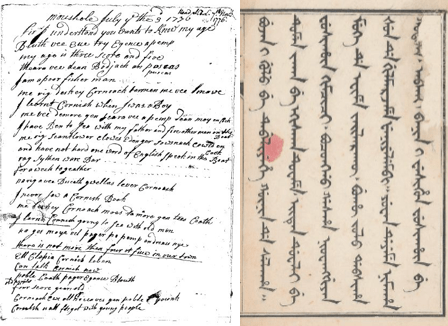
Bodinar, W. (1776). [Image of letter by William Bodinar regarding Cornish language]. Wikimedia Commons. https://commons.wikimedia.org/wiki/File:Lether_Bodinar.jpg
Kangxi, Kuixu & Shen, Y. (1712). Emperor’s Poems, in Manchu Language, on Bishu Shanzhuang, the Imperial Summer Mountain Resort: Two Juan. Qing Imperial Court
Skillful654321. (1970). [Image of Vietnam War demonstration]. Wikimedia Commons. https://commons.wikimedia.org/wiki/File:Nu_gay_lib_demo_03.jpg. Under CC BY-SA 4.0 License.
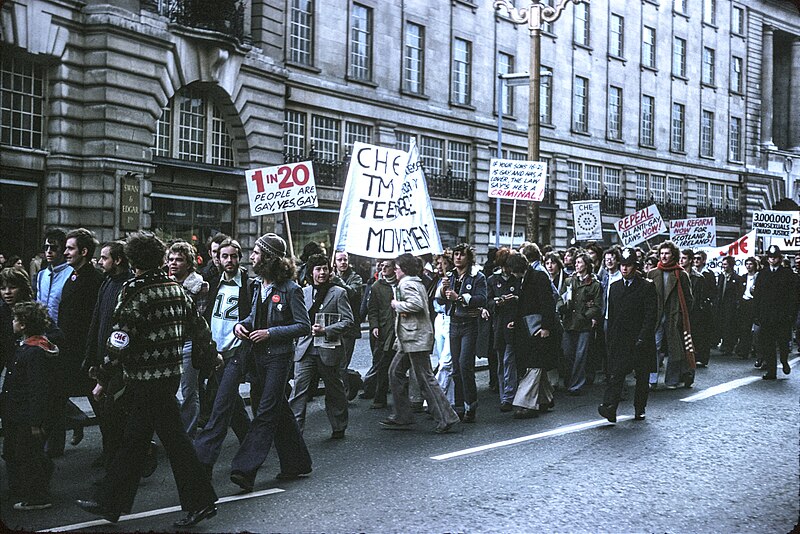
Strzelecki, J. (1975). [Demonstration in support of LGBT in London, December 1975]. Wikimedia Commons. https://commons.wikimedia.org/wiki/File:Demonstration_in_support_of_LGBT_in_London,_December_1975_02(js).jpg. Under CC BY-SA 3.0 License.
 Boyno Polari


.jpg)
Leave a comment